
Latest Posts
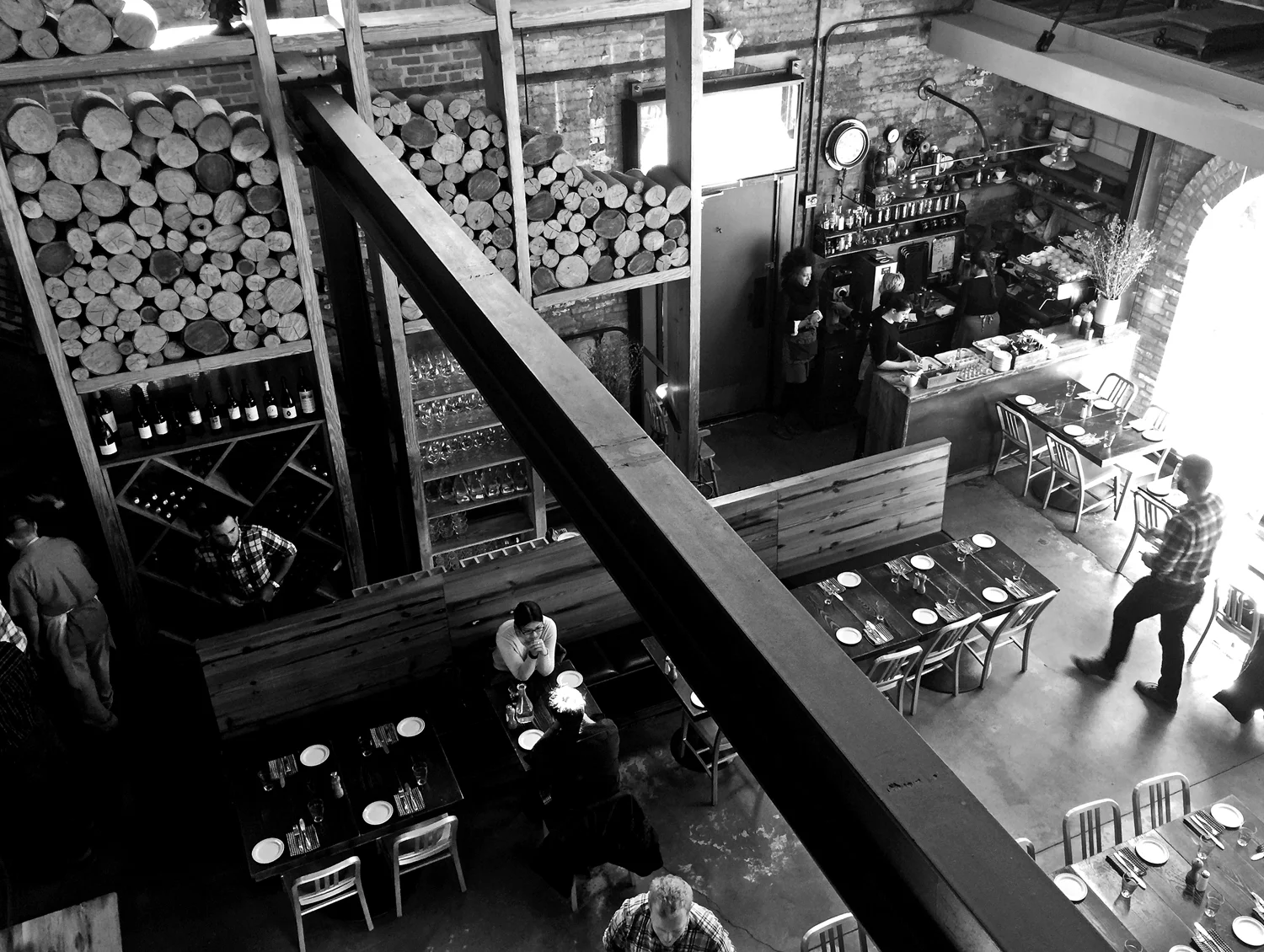
Woodberry Kitchen at First Light
Baltimore's Woodberry Kitchen is not only a wonderful place to eat, but also quite a place to enjoy its visual character.
Woodberry Kitchen, an excellent restaurant in Baltimore, Maryland, finds itself nestled in various layers of interesting communities.
The area is referred to as Hampden, itself part of Woodberry. The building that the eatery calls home is near a series of mills known as Union Mill and sits in the current Clipper Mill Park. Eleven mills were originally in the area of Jones Falls, settled in 1661 by David Jones.
Woodberry was based around 19th century mills which brought beautiful stone homes and a thriving industry. Frederick County grain was processed here as early as 1802. Today, various mills are repurposed as shops, offices and ling spaces.
Union Mill was built in 1866 as the world’s largest producer of cotton duck, a heavy, woven cotton fabric. Its uses range from sneakers to painting canvas.
Clipper Mill (originally known as the Union Machine Shops) shares the remains of the former Poole and Hunt Foundry, dating to the 1850s. The site manufactured steam engines, boilers, saw-mills and railroad cars. Rail siding and track helped move materials in and products out. The columns that support the U.S. Capitol dome were cast at Clipper Mill, and cannon barrels and balls were cast during our own Civil War.
After a 1920s bankruptcy, the Franklin Balmar Company took over, manufacturing airplane wings and parts for the Manhattan Project during World War II.
A substantial fire in 1995 changed the building forever, but allowed completely new uses via redevelopment. Early in the new century, it evolved into the Clipper Mill Park. The restaurant sits in what was once the foundry building, a stone structure constructed in 1870 with additions added during the remainder of the 19th century. Its neighbors now include several artistic studios.
The Poole and Hunt buildings are registered with the Maryland Historical Trust as a Maryland National Register Property.
Woodberry Kitchen, Baltimore, Maryland
http://www.facebook.com/WoodberryKitchen
http://www.woodberrykitchen.com/

Molasses Milo (Sorghum) Cake
The local Union Mills Homestead offers their own stone-ground flours, and spotting milo flour put me in pursuit of a worthy baked item with the flour. I think we've come up with one.
I'm fortunate, living in the southern part of Pennsylvania, to live near many sites linked to early America and its history. In some cases, there are related links to older or different products dealing with the foods we eat. The milo flour in the attached cake recipe is one such exmple.
Just over the Mason-Dixon line in Maryland is the Union Mills homestead, complete with an operating brick grist mill that provides the area with stone ground cornmeal and flours. On one visit, I picked up a small sample of milo flour, a new item they were experimenting with. Milo is a drought-resistent sorghum grain. Sorghum cereals are used for livestock feed and syrup-like sweeteners. Its flours are gluten-free and high in protein and fiber. While it can have a bit of a gritty texture in baked goods, this can be used effectively in the right recipes.
One downside to milo in baking is its tendency to make crumbly cakes and cookies. The great folks at Union Mills warned me of the issue, and suggested that I mix the flour with another, rather than using only the milo. In addition, they found that adding coconut oil in recipes with the sorghum was beneficial. While coconut oil is high in staurated fat, its lauric acid seems to have much less of a negative impact than many other saturated fats. Milo flour is shown beside more traditional flour in the photograph below.
Recipes utilizing a high proportion of sorghum flours are not overly abundent, but I found a cookie recipe on the Whole Grains Council web site that looked enticing:
http://wholegrainscouncil.org/recipes/snacks-desserts/molasses-sorghum-cookies
The recipe originated in Sara Baer-Sinnott's "The Oldways Table." It was excellent, although as expected, crumbled quite easily; definitely worth working with for its nice, dark flavor and unique texture offered by the milo flour.
My first attempt was to add the coconut oil and try it as a bar cookie; the effort was again tasty, but difficult to hold together. It was very light and cake-like, so I went with its strengths and moved to a cake format by adding another flour: both cake and/or bread flours worked suitably, and created a low-rising cake that can be eaten as a finger food, as are most brownies. No icing is needed, although a dusting of confectioner's sugar is a nice touch.
If served with no powdered sugar, each of the twelve suggested servings yields 227 calories. Yeah, saturated fat is high. Splurge!
I've become a fan of the cake, and it's become a regular snack item here in the house. Feel free to download the recipe in pdf form here:
http://visualrealia.drupalgardens.com/sites/g/files/g389126/f/201511/MiloCakeRecipe.pdf
If you can't find sorghum flours locally, those in the area will enjoy a visit to Union Mills to pick up some directly.

Hanover's "Caged" Lion
Herman Miller, architect for Hanover’s well-known Sheppard and Meyers homes, was also the architect for the grand, four column PNC Bank found in the first block of Carlisle Street, just a few footsteps away from our square. Traffic, both by car and foot, passes by this building daily, with very few knowing about Hanover’s “caged” lion. Read more and view our favorite feline by reading the complete post.
Hanover Saving Fund Society's Lion
Herman Miller, architect for Hanover’s well-known Sheppard and Myers homes, was also the architect for the grand, four column PNC Bank found in the first block of Carlisle Street, just a few footsteps away from our square. Traffic, both by car and foot, passes by this building daily, with very few knowing about Hanover’s “caged” lion.
Originally known as the home of Hanover Saving Fund Society, the institution was chartered on April 14, 1835, by “Matthias N. Forney, Henry Meyers, Peter Muller, Henry C. Wampler, David Diehl, Daniel Barnitz, William Bair, Daniel P. Lange, Peter Winebrenner, William D. Gobrecht, George Gitt, John L. Hinkle, Benjamin Welsh, Adam Alt, Samuel Trone, Jacob Hilt, and David Slagle of Hanover Borough and Samuel Hornish, George Eichelberger, and Charles Cremer of Heidelberg Township, York County…” (Source: Immigrant Entrepreneurship) Why include this list here? Hanover residents will note the familiarity of many of these surnames.
The cash capital at the time of charter was $10,000. Records show that deposits held in August of 1875 were $590,228, which received 5% interest. Interest in 1884 was listed as 3%.
The published “Reports of the Several Banks and Savings Institutions and Banks Organized under the Free banking Law of Pennsylvania,” published by the State Printer in Harrisburg in 1891, includes a report for the Hanover Savings Fund Society. The 1890 assessed value for the previous property in 1890 was $7,000. Bonds held and owned by the Society in 1890 included ones for various railroad companies and Western Union, as well as gas and water companies.
Originally known as the Hanover Saving Fund Society
Architect Herman Miller was born in the Roxborough area of Philadelphia, and helped design numerous respected facilities in that area. He went on to set out on his own by 1898, with a noted specialty in the design of hospitals and banks. In addition to Hanover’s, he is also the architect of our neighbor’s Gettysburg National Bank a few years later. The Philadelphia Architects and Buildings institution holds five drawings from Miller’s work on the Hanover project.
The Neoclassical concrete and brick structure we see downtown was erected in 1906 for approximately $100,000. It features Barre Vermont granite and American Pavanaza marble. The bank later was known as the Bank of Hanover, and is now owned by PNC Bank. The structure features a lion sculpture above the doorway, but later changes at the front have altered the view so the glass-encased figure is difficult to see by pedestrians at ground level. The photograph included here was captured from the roof of the Heritage and Conference Center, enabling a rare view of Hanover’s hidden feline.
Sources:
http://www.philadelphiabuildings.org/pab/app/ar_display.cfm/27059
http://www.philadelphiabuildings.org/pab/app/ho_display.cfm/57125
http://files.usgwarchives.net/pa/york/history/gibson/hanover-sav-fund.txt
http://www.livingplaces.com/PA/York_County/Hanover_Borough/Hanover_Histo...
http://immigrantentrepreneurship.org/entry.php?rec=197
https://books.google.com/books?id=JQYWAAAAYAAJ&pg=PA121&lpg=PA121&dq=han...
“York’s Historic Architecture” by Scott D. Butcher, The History Press, 2008
http://amzn.to/29D59vy

John's Burnt Bridge
John's Burnt Bridge (sometimes referred to as the Camelback Bridge) was built sometime around 1820, and is a beautiful structure that is often driven over without appreciating its excellent stonework. Read the article for more historical information.
John's Burnt Bridge, built between 1800-1824. Rehabilitation occurred in 2005-2006.
Located roughly six miles from Hanover, not far off of Centennial Road, is a small bridge easily driven over without noticing its beautiful structure and historical significance. John’s Burnt Mill Bridge, sometimes referred to locally as Camelback Bridge, was accepted into the list of National Register of Historic Places in 1974. (Its official designation for the county is Bridge No. 56.) It spans the south branch of the Conewago Creek in Mount Pleasant and Oxford Townships, Pennsylvania.
While there are some discrepancies regarding the construction date of the bridge, ranging from 1800 through 1824, the nomination form lists the range of 1800-1823. A plaque on the bridge marking its rehabilitation in 2005-2006 noted the original construction date as 1820.
Reconstruction Plaque
The roughly 75 foot long bridge has a main section approximately 50 feet in length with approaches (at the time of the nomination) twelve feet each in length, with walls four and a half feet higher than the road surface.
The style of the three arch structure, constructed from local fieldstone, predates the use of most covered bridges. Its seven and nine foot high arches were constructed using wooden frames, with seven visible metal tie rods (housed in metal shells) giving additional support. Once the arch keystones were placed, the wooden forms were removed. Two stone “icebreakers” jut from the area between the arches on each side.
Nine similar bridges were built in Adams County prior to 1825, but at the time of application, only two were surviving. The style is noted for its durability, but a newspaper article in 1972 noted consideration for replacing the structure with a modern structure. This was obviously not carried out, but major rehabilitation efforts in 2005-2006 were taken by Mechanicsburg’s Pennoni Associates, Inc., at a cost of $840,000.
From both a cost and historic perspective, rehabilitation was deemed preferable over replacement. The bridge’s location along a floodway provided challenges to the structure throughout its life, as well as to the rehabilitation process. Flooding probably led to much of the structural problems, and in particular, a weather event in January of 1996 led to a flooding and freezing cycle that led to numerous cracking issues. One of the primary improvements was the installation of precast concrete “backing blocks” that strengthened the arch structures and allowed the removal of a previous 15 ton weight limit on the bridge.
The project was deemed a success to the degree that the Association for Bridge Construction awarded it an Outstanding Rehabilitated Bridge designation. The National Cooperative Highway Research Program includes it as a case study in its guidelines for historic bridge work.
The bridge is noted in the NRHP nomination form for its representation of local stone architecture, as well as its part in a rural community centered around a mill and stream. It originally was located with twelve stone homes dating before 1850.
John’s Burnt Mill Bridge is one of 33 Adams County locations noted in the National Register of Historic Places, and one of five Adams County bridges on the list.
Informational Resources:
National Register of Historic Places Nomination Form - #74001731
U.S. Department of the Interior
National Park Service
Bridgehunter.com
http://bridgehunter.com/pa/adams/17216042830560/
Historic Bridge Foundation
http://historicbridgefoundation.com/wp-content/uploads/2014/01/burntmill...
Center for Environmental Excellence
http://environment.transportation.org/pdf/communities_of_practice/finalr...
Adams County
http://www.adamscounty.us/Munic/Documents/CompPlans/EasternAdamsCountyJo...

Yogurt and Blackberry Paleta
Summer means fresh, current produce to food lovers. For me, summer means fruit paletas.

Yogurt and Blackberries make a wonderful summer snack!
Summer is the season for fresh fruit, so it’s also the obvious time of year to make and enjoy frozen fruit desserts like ice cream and paletas.
I’ve been exploring frozen popsicles a bit lately after picking up a great new book on the subject, Paletas: Authentic Recipes for Mexican Ice Pops, Shaved Ice & Aguas Frescas by Fany Gerson. The book lists for $16.99, but it’s usually available for less. It’s a bargain at full price.
Gerson, a graduate of the Culinary Institute of America, can certainly be considered an expert on the subject after running La Newyorkina, New York’s premiere experience for frozen Mexican treats.
So far my paletas expedition has focused on sour cream based popsicles and those using yogurt. Since I’m a fan of homemade yogurt using local milk (Apple Valley Dairy in East Berlin, Pennsylvania) I’ve spent more time making new varieties of this style with the current fresh fruit in season at the local markets. Fresh ingredients make great food, and nothing beats buying the produce from those that grow it, or at least as early in the retail chain as possible. And any recipe that uses only six ingredients gets bonus points in my mind.
Gerson’s paletas de yogurt con moras (yogurt ice pops with berries) have been great with all of the fruits I’ve tried so far. For my latest treats, I used some large, fresh blackberries I picked up locally. Because of their size, I cut each berry in halves or thirds.
Ingredients
1 lemon
½ cup water
½ cup sugar
1 ½ cups plain greek yogurt
2 tablespoons honey
2 cups fresh berries
The recipe may be found online (printed with permission) at the Cooking Channel web site, but the process begins with creating a lemon-infused simple syrup, easily created with the sugar, water, and lemon peels. As a side benefit, the peels, discarded after creating the syrup, are great placed in a summer drink.

A very basic syrup with lemon for flavor.

Greek yogurt can be purchased or traditional yogurt can be strained.
Greek yogurt may be purchased, but as a homemade yogurt enthusiast, I simply placed my own yogurt in a sieve until most of the whey was drained. This excellent, thick yogurt was added to the honey and lemon syrup and blended until smooth.

Molds are a great investment for popsicle/paleta treats.
A small amount of this popsicle base is poured into either a commercial mold or any small containers of your choice. After placing the molds in a freezer for a bit, pieces of the blackberries or other fruit are added to the mold. The remainder of the sweetened yogurt base is then added to each popsicle until it reaches just below the top of each mold or container. Sticks may be added at this point, and a lid if applicable. After a few hours in the freezer, these frigid treats are ready to enjoy.
By placing the molds partially into a pot of warm water for a few seconds, the popsicles will release from the container. The yogurt base does melt fairly quickly at this point, so have small plastic bags ready and return to the freezer. (As a cheapskate, I place two popsicles into each bag.)

Be patient while they freeze! :)
Take another look at the recipe ingredients above… difficult to buy commercial frozen treats when making your own yields a better tasting popsicle and one where you can control the ingredients inside. Even after trying only two recipes in Ms. Gerson’s book, I feel that I’ve already gotten my money’s worth in value. I’d highly recommend a purchase. I’ve included links to the other items that would be handy, but not necessary. Give paletas a try.
Resources
Popsicle Mold: Norpro Ice Pop Maker
Popsicle Sticks: Progressive International 50-Count Wood Freezer Pop Sticks
Book: Paletas: Authentic Recipes for Mexican Ice Pops, Shaved Ice & Aguas Frescas
Milk: Apple Valley Creamery
Fruit: K & J Farm Market and the Adams County Farm Fresh Markets
Recipe Online: Cooking Channel
Gettysburg Restaurant Recommendations
Visiting Gettysburg? Here's where to eat...
While there are many restaurants in Gettysburg that I'm sure are worthwhile that I've not listed here, this list includes places that I can personally recommend from experience. Facebook links (restaurant name) and website links are included. (Last updated 01/11/25.)
• Pizza/Subs
Their diced tomato, feta, and jalapeño pizza is the best pizza in town.
• Pub/Bar
Sign of the Buck
29 Chambersburg Street
Website
The best of both tavern and upscale foods. Very reasonably priced lunch options, and in a time of fewer Sunday brunches, don’t forget that option, too.
The Garryowen Irish Pub
126 Chambersburg St
Website
Appalachian Brewing
259 Steinwehr Ave
Website
Appalachian feels a bit like a larger chain, but you’ll find some nice food and drink selections.
• Mexican
Montezuma
225 Buford Avenue
Website
• Italian
La Bella Italia
402 York Street
Website
Waitstaff can sometimes be overtaxed, but the food is good if you’re not in a hurry.
• Diner/American
Food 101
101 Chambersburg Street
Website
Gettysburg Baking Company
17 Lincoln Square
Website
• Upscale
Dobbin House Tavern
89 Steinwehr Avenue
Website
• Not in Gettysburg, But Close Enough...
Gateau Monique Bakery
5 South Queen Street, Littlestown
Website
Scones, cupcakes, cheesecake, tarts, you name it... you'll love it here. Worth a morning drive from wherever you're at.
C&D Bar & Grill
6465 York Road, New Oxford
Website
Inn 94
4805 Carlisle Pike, New Oxford
Website
In the neighbrohood of nearby Hanover? If so, pick up some Hanover suggestions by clicking here.