
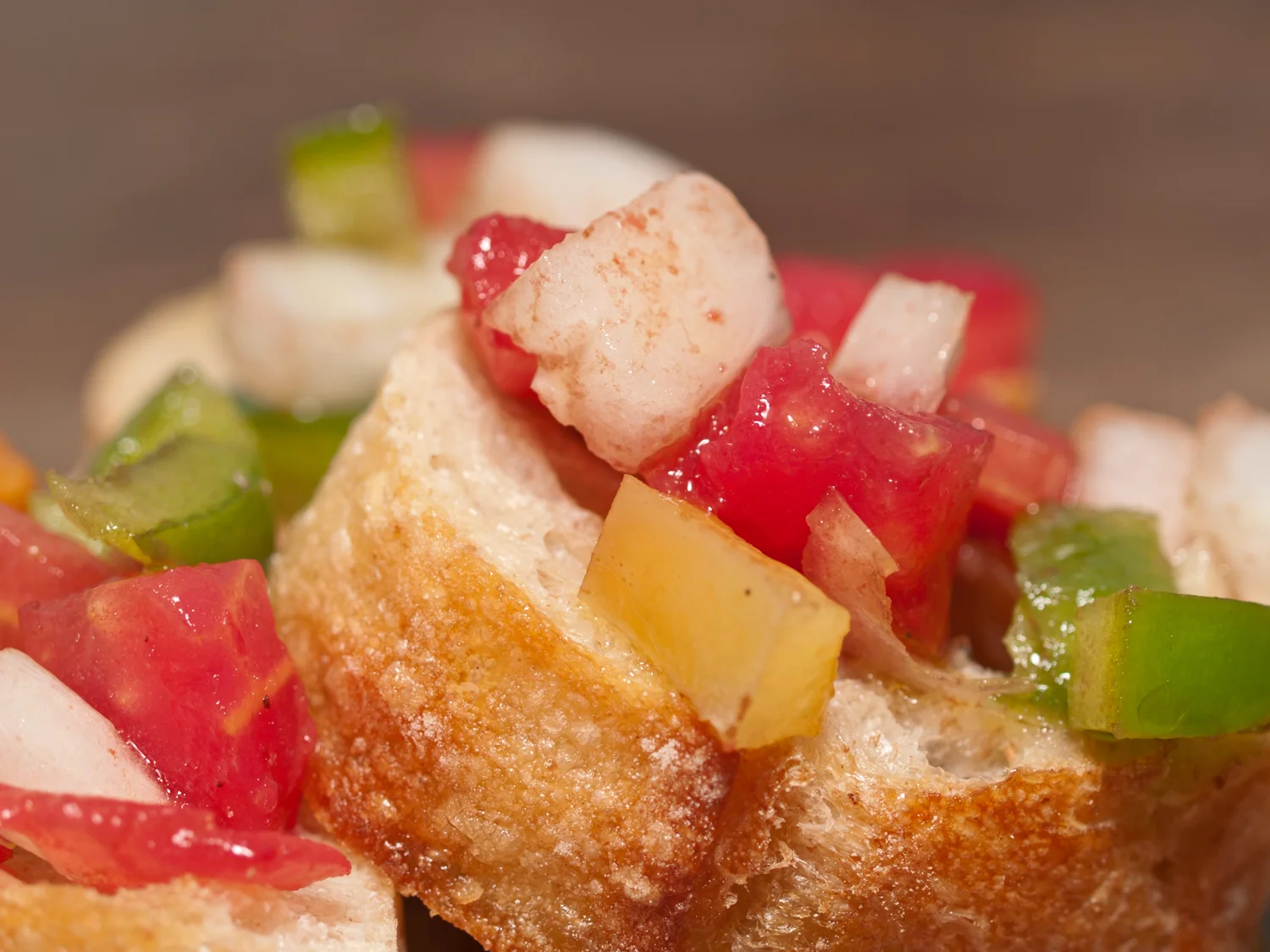
Bruschetta
Bruschetta! Grab a recipe for this summertime treat.
Bruschetta? Salsa? Always a tough decision when I come away from the farmers' market with fresh tomatoes, peppers and onions. Our family loves them both, and they are very similar in flavor. In some cases, the decision is based upon the availability of a great bread.
Whenever possible, I like to use a mix of tomatoes for both salsa and bruschetta. Not only will the variety of colors be appetizing, but each tomato will have a unique taste and texture which makes the end result more interesting.
After an "x" cut in one or both ends of the tomatoes, they are quickly parboiled and cooled to be able to remove the peels. The tomatoes are cleaned and diced along with the peppers, garlic and onion. (Use the peppers that grab your attention at the market and adjust for your own heat taste.) Olive oil and balsamic vinegar are added, as well as salt and pepper.
Slice your bread into appropriately-sized wedges. While baguettes make this an easy step, it's not difficult to cut other shapes; the last time I made bruschetta I used a sourdough loaf that woked wonderfully. Olive oil is added to one side of the bread wedges and toasted for several minutes in the oven. Serve on the warm toast or place the bread in a plastic bag after cooling if serving at a later time.
Our favorite recipe is adapted from the Simply Recipes web site. My version is available to download by clicking here.

Grilled Salsa
Homemade salsa can't be beat... unless you grill some of the vegetables first.
Fresh summer vegetables from Pennsylvania's Adams County, and I'm sure your area, make some specific recipes jump to our minds. For our family, one of our favorite summer treats is a fresh, homemade salsa. There are as many recipes for salsa as there are people making it, and my version seems to change every time I make it.
That variety is a positive thing; I use my recipe as a road map. Start with a basic plan, but pick the best looking, freshest ingredients and adapt the map to fit the produce. The downloadable recipe below can be a starting point. Use what you pick up at your local market. (My ingredients were from the always wonderful Adams County Farm Fresh Markets in Gettysburg, Pennsylvania.)
While raw veggies in a salsa are great as is, grilling some can add some depth to the texture, color and taste. I tend to use both grilled and raw ingredients, and will even use both versions of the same ingredient. (Particularly the tomatoes; grill some and leave others raw. In this batch, the larger tomatoes are grilled while the small ones were raw.) After prepping the vegetables, the ones to be grilled are placed on the grill rack and pulled off as each reached the perfect stage. The attached recipe notes my suggestions, but adapt to your preference.
For the tomatoes, for example, I tend to pull them off when the skins begin to pull loose. At that stage, it's easy to remove them with your fingers or tongs.
After doing a rough chop of the grilled and raw vegetables, the salt, olive oil, vinegar and lime juice are added.
I've found the best flavor to be after chilling the salsa for a few hours, but certainly eaten with a day or two. If your family is like mine, you won't have any problems finishing this treat during the first sitting.
To download an easily-printed pdf file of the recipe, click here. Let me know what you think or note what you do in your salsa recipe below in the comment section.
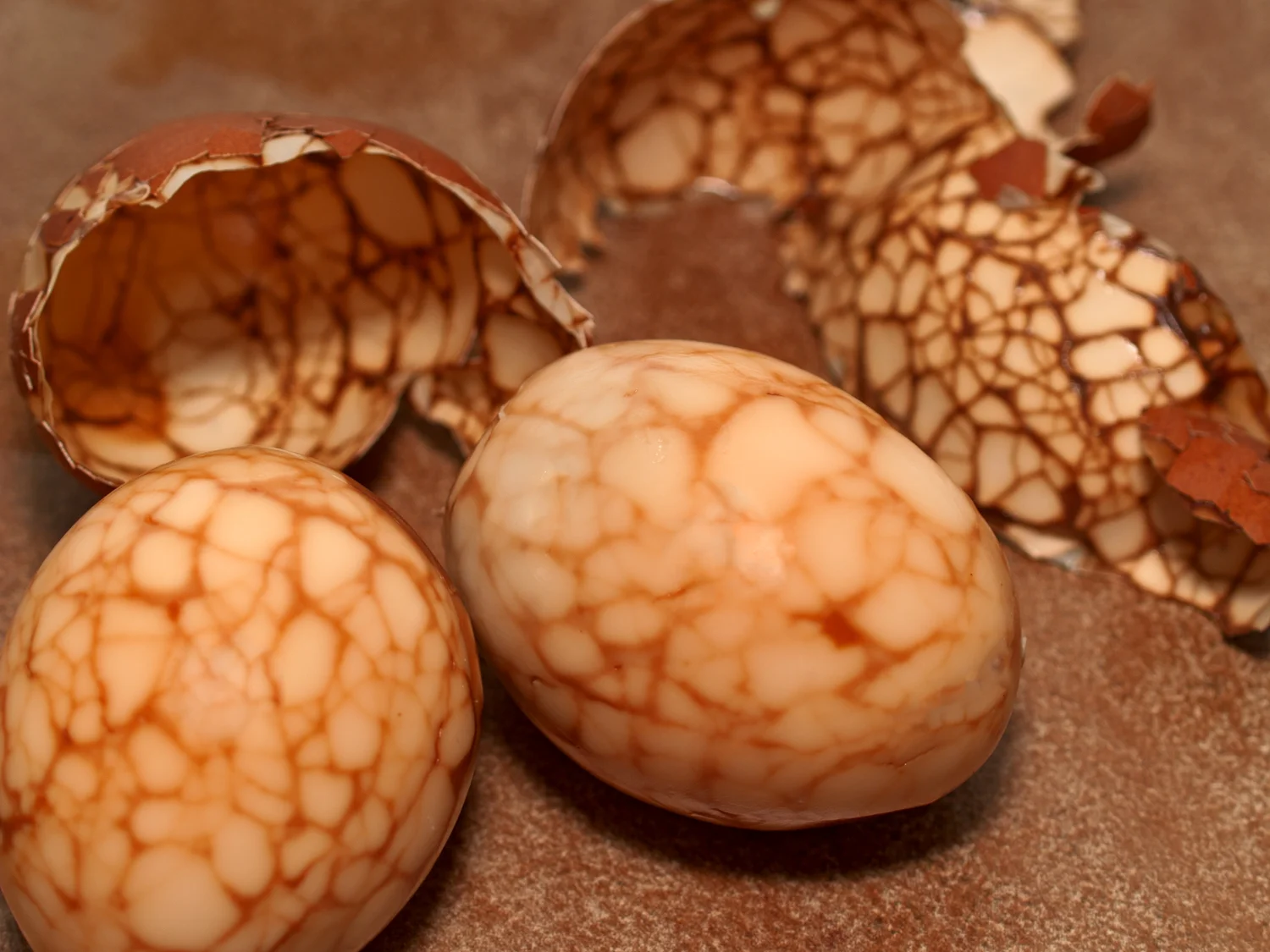
茶叶蛋 Chinese Tea Eggs
Art or snack?
Yes.
茶叶蛋 Chinese Tea Eggs
The visual appeal of any ingredient or food is obviously important in creating a hunger for it, but even after seeing a wonderful food photograph, I’ll read the ingredient list and recipe instructions before deciding if it is something I wish to try making for myself. Chinese tea eggs are an exception; their beautiful designs are intriguing and made experimenting with them something to look forward to.
These spiced treats are often household items in China, but are also sold by street vendors there, in addition to being popular in areas such as Hong Kong and Taiwan. While there are variations in the techniques of preparing tea eggs, they all essentially involve a combination of boiling and/or simmering shell-on eggs in a spiced mixture usually containing dark tea leaves and soy sauce. Anise, cinnamon and peppercorns are also commonly added.
To increase the intensity of both the coloring and flavor, the egg shells are cracked to allow the spice mixture to reach the edible part of the egg. These random cracks in the shell also create the visual texture when the eggs are opened to be eaten.
In the recipe I used from the Appetite for China web site, the simmering liquid used water, tea leaves, soy sauce, salt, sugar, star anise, cinnamon and black peppercorns. The smell throughout the house was a side benefit.
The resulting coloring was not only evident in the egg, but also created a snake skin-like appearance on the shells.

Beef Jerky
Wait... You don't have a jerky recipe? Better grab my recipe.
Don't worry too much about storage. You'll be eating this right away.
Beef jerky has always been a welcome treat, but taking one look at the ingredients list of commercial jerky quickly dulls the appetite. By using a high quality, local meat and a flavorful marinade, an excellent jerky can easily be made that will ensure you that the end result is something you'll look forward to.
The marinade discussed below and available via the download link is appropriate for one pound of meat. In the case of beef jerky, I pick up very thinly sliced steaks from a local, trusted butcher.
2 tsp Brown Sugar
1 tsp Salt
1 tsp Onion Powder
1 tsp Dry Mustard (Powder)
½ tsp Garlic Powder
⅜ tsp Cayenne Pepper
¼ tsp Black Pepper
¼ cup Wine, Cider, Etc.
¼ cup Soy Sauce
1 Tbsp Worcestershire Sauce
2 tsp Liquid Smoke
¼ tsp Tabasco Sauce, adjust as preferred
For ease in preparation, mix the dry ingredients in a one gallon ziplock bag.
Add the remaining liquid ingredients and mix well. Place the beef or other meat into the bag, being careful to separate any slices as much as possible. Marinade in the refrigerator 8-12 hours or longer, tumbling the bag occasionally to expose all areas of the meat.
Dehydrate for several hours, turning the beef slices every few hours to ensure drying on both sides. Store the jerky in the refrigerator to ensure safety.
Download a printable pdf file of the marinade recipe by clicking here.

Peanut Butter
Peanut butter! Sometimes that is all that needs to be said. Or eaten.
Aside from those with peanut allergies, I know of very few folks who don't enjoy indulging in peanut butter, and there are probably even fewer of us that don't have memories of enjoying peanut butter as a kid. There's something basic about peanut butter, and that classic nature probably stems from the simplicity of the food.
As great (and tempting) as it is to be able to stick that spoon into the jar of peanut butter and lick it clean, there's no reason not to reach for peanut butter that's even better; peanut butter is incredibly easy to make at home and will make your taste buds even happier. When I made my first batch, I quickly asked myself why I hadn't done it sooner.
Trusting Alton Brown's experiments in recipe formation, I knew that his recipe would be a great starting point. When I concluded my early attempts, I made very few changes. I roast the peanuts without adding salt and peanut oil as Alton does, instead sticking to those ingredient in the later stage of processing. In addition, I find it necessary to increase the amount of oil necessary when making the butter. In all other ways, the recipe is as he presents it. (Click here to go to the original recipe on the Food Network web site.)
While homemade peanut butter can be made with purchased roasted peanuts, roasting is incredibly simple and provides an amazing aroma in your kitchen that makes the whole project worth the price of admission. And how else can you ensure a fresher end product? In my area, the local Weis grocery store chain sells 15 ounce bags of raw peanuts (Pardoe's Perky Peanuts, in this case) that are perfect for this recipe. The peanuts are spread in a single layer on two cookie sheets lined with parchment paper or silicone mats. I've found that 15 to 20 minutes of roasting time at 400℉ is a reasonable roasting time, stirring once or twice in the middle. I'd suggest experimenting with how dark or light you'd like the peanuts; darker roasting pushes the nutty flavor even more forward, but there is a "too dark" line. (In the photographs in this post, I'm using a roast that probably is about as dark as I'd recommend. A few dark peanuts are perfectly fine, but you may want to roast to a slightly lighter color on your first attempt.)
The roasted peanuts are placed in a food processor with the salt and honey. I use a smoked salt and a dark, thick, local honey for interest, but feel free to use what is available to you. This mixture is processed for several minutes until the peanuts are quite crumbly. Crumbly... a great word!
Three tablespoons or so of peanut oil (That makes sense!) is slowly drizzled into the peanut mixture as it is further processed, and gradually the magic that is peanut butter will form before your eyes. How smoothly would you like your peanut butter? Your call!
I'll note that I increased the amount of peanut oil substantially over Mr. Browns' suggestion. Feel free to play with the amount until you come up with your preferred texture.
This incredibly flavorful butter will knock your socks off. The difference between it and the commercial variety is quite substantial. Eat it in a sandwich or place it in your favorite recipes, as I did in the foods shown below. Want to be a radical? Grab that spoon and eat it right out of the food processor.
Download a one page printable pdf file of my slightly adapted version of the peanut butter recipe by clicking here.
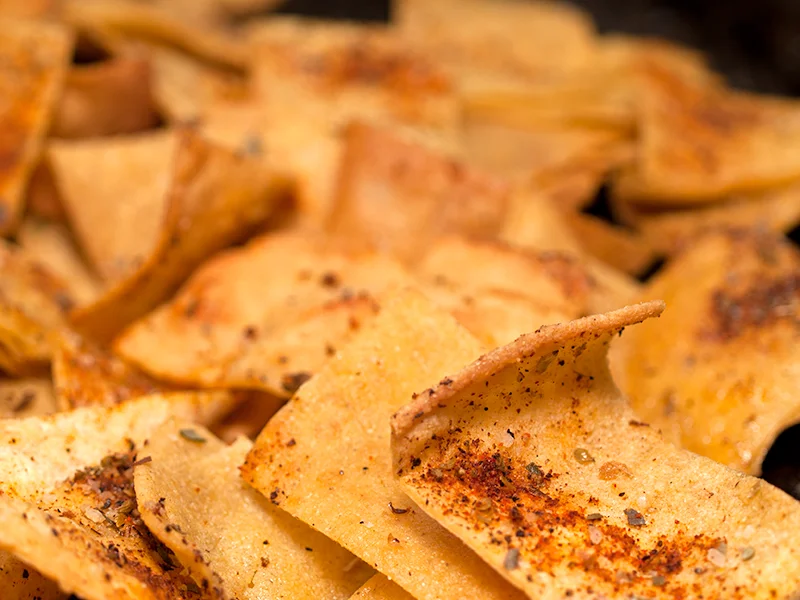
Seasoned Corn Chips
A slightly healthier (olive oil) seasoned corn chip, prepared easily in a cast iron skillet, with equally easy cleanup.
While making homemade tortilla strips for salads, I stumbled upon a method that reminded me more of a commercial corn chip than either fried or baked tortilla chips. By combining both processes and adding seasonings, one can end up with a nice snacking chip that would hold up to a dip or be flavorful enough to skip the dip completely. While the steps start with frying, only three tablespoons of olive oil is used in the pan.
While any oven-proof pan can work, this process seems made for a cast iron pan, which also cleans easily afterward. I will note that these pick up moisture easily, so store in an airtight bag or container.
This recipe lends itself to experimentation with various seasonings.
Click here for a link to a printable recipe download.