
Latest Posts




Fiction: A Figurative Abstraction Exhibit of Clay Monoprints
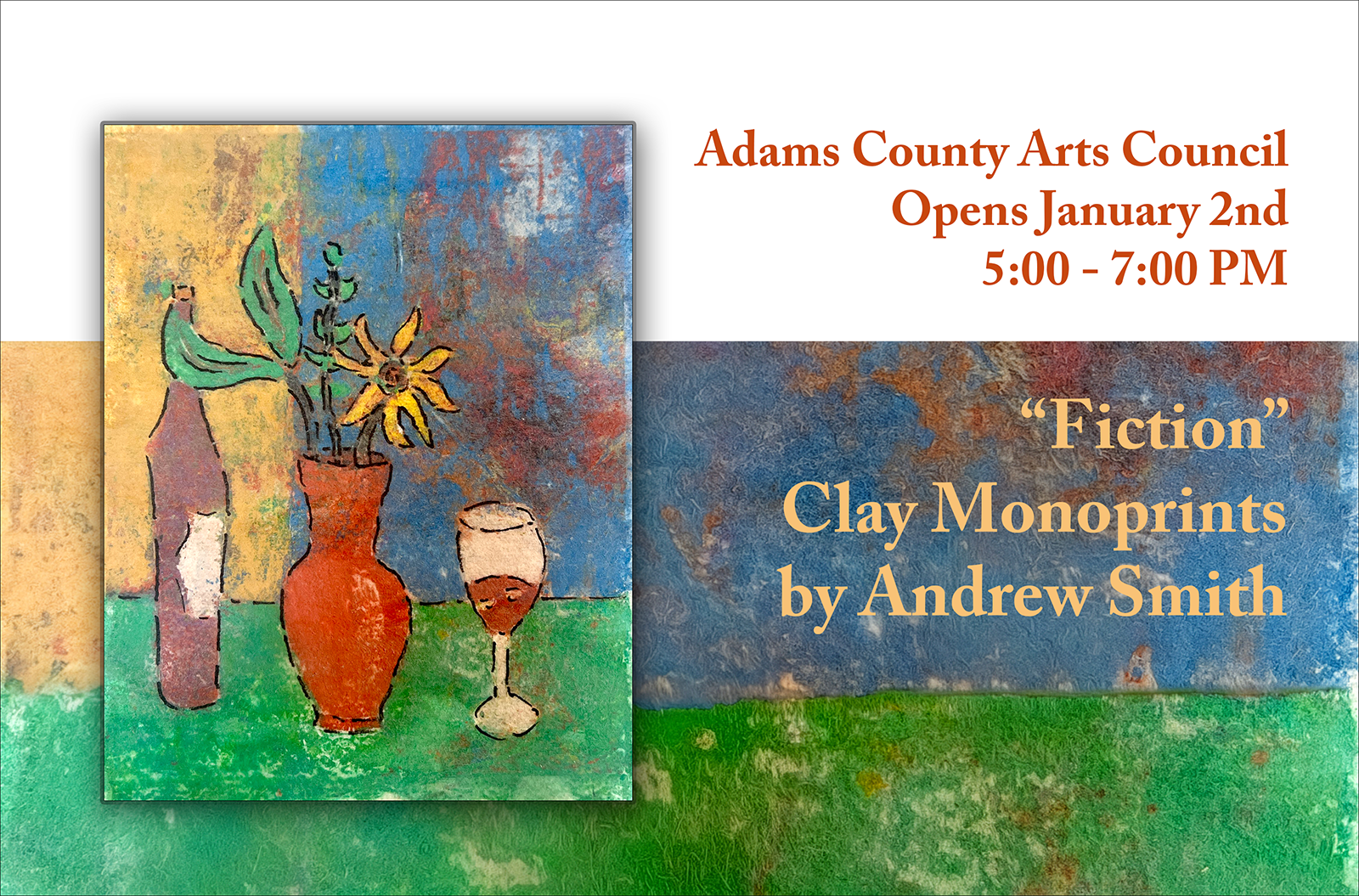
This Friday, January 2nd, I’ll have an exhibit opening featuring clay monoprint works — a medium developed in Pennsylvania. The collection of works focuses on art that can be considered figurative abstraction: recognizable, real-world forms portrayed in abstract ways.
“Fiction” Exhibit Opens January 2nd, 2026
This Friday, January 2nd, I’ll have an exhibit opening featuring clay monoprint works — a medium developed in Pennsylvania. The collection of works focuses on art that can be considered figurative abstraction: recognizable, real-world forms portrayed in abstract ways. See the works and other exhibits on First Friday from 5:00 to 7:00 PM.
"Fiction"
Clay Monoprint Exhibit
Adams County Arts Council
125 S. Washington Street, Gettysburg, PA
January 2026
First Friday Reception:
Friday, January 2nd, 2026
5:00 - 7:00 PM
Exhibit Artist Statement:
Artist Statement for Fiction
(Adams County Arts Council, January 2026)
In Fiction, I present a body of work that dwells in the space between representation and abstraction. Each piece emerges from the clay monoprint process—a method that combines the painter’s intent with the medium’s nature. Working on a slab of clay known as the matrix, I layer pigments and brushstrokes while allowing remnants of previous works to shape its evolving history. The results are neither purely imagined nor purely seen; they are translations of process and imagination into visual form.
The clay monoprint art form is relatively new, and many works are experiments that resist easy classification within traditional styles or movements. For this exhibit, I use the phrase “material-oriented figurative abstraction” because it captures that tension: forms may suggest vessels, landscapes, or other familiar objects, yet they never resolve into literal images. Instead, they become echoes of both past and present. The clay, pigment, and chance determine as much of the outcome as my own intent. The way the clay transfers to the material (often Pellon) becomes part of the work’s meaning, influencing future prints. Process and material are inseparable from the final image.
The matrix itself is a record: each layer of clay slips and pigment, embedded into the clay slab, is captured in time. I do not erase those echoes; I lean into them. Layers accumulate, and remnants of earlier imagery reappear unexpectedly, as though the clay recalls its past and chooses to speak. In this way, the material is both subject and medium, holding within it the memory of this transformation.
The title “Fiction” suggests that what you are seeing is not a direct representation of something tangible—it is a narrative shaped by memory, of what remains after the artist and chance collide. Even when a work seems to reference something familiar, it is always a story built from clay, artist marks, and the intent of the matrix itself.
This collection at the Adams County Arts Council encompasses not only the works on display but also the histories that shaped them. Ultimately, these monoprints are tactile and limited by the present. Peer closely at the surface and recognize that fiction—like art itself—is past and present transformed.

"Pigment" Reception & Exhibit Extension
Andrew Smith’s (Visual Realia) “Pigment” exhibit is extended through August.
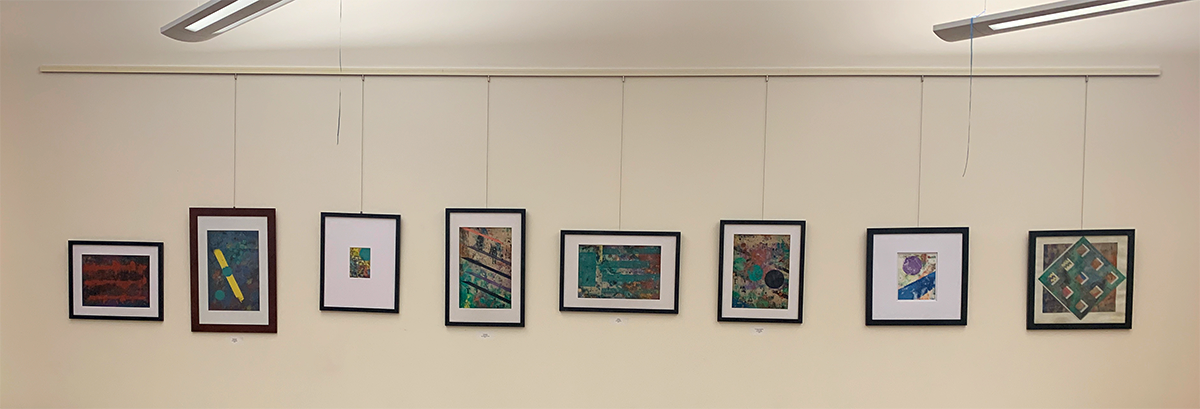


The “Pigment” exhibit of clay monoprints by Andrew Smith of Visual Realia has been extended through August and refreshed. The exhibit for the month has twenty-six works, with seven prints new to the Gallery display.
The exhibit can be seen during the Adams County Arts Council’s regular hours, or by contacting Andy for after-hours access. In addition, the exhibit will be part of the Arts Council’s First Friday reception, running from 5-7:30 PM on Friday, August 6th. Andy will be present and will have the clay matrix used for the prints in the gallery. Questions are welcome!
The Adams County Arts Council is located at 125 South Washington Street, Gettysburg, Pennsylvania.
"Under the Ridge" Up for Auction

“Under the Ridge” by Andrew Smith of Visual Realia
In 2018, Hanover Against Hunger packed close to 120,000 meals to be distributed worldwide where needed. This amazing local group raises funds for the project locally, including a silent auction of fourteen artworks.
My entry is "Under the Ridge," a 24" x 20" look down toward the town of Gettysburg from Seminary Ridge. (The building shown is part of the United Lutheran Seminary.)
To bid on the work or see the others available via auction, visit:
https://hanoverareaarts.com/auction-gallery/
You may also view the works in person at the Hanover Area Arts Guild, located at 32 Carlisle Street, Hanover.
To learn more about Hanover Against Hunger, visit their website at:
https://hanoveragainsthunger.org
It's a wonderful organization with an impressive reach. Volunteer or place a bid!

Vanishing Village
Nestled between Hanover and McSherrystown is a small village with a vanishing name.
Entering Adams County from the York County Line, Pennsylvania
There was a time when drivers traveling between Hanover and McSherrytown on Route 116 would pass small signs noting the village name of Midway. Businesses noted the name. Today, visual remnants of the name are seldom found.
Midway, located in Conewago Township, Adams County, Pennsylvania, borders Hanover (in York County) and McSherrystown. It is considered an unincorporated census-designated place, or a CDP. The United States Census Bureau considers CDPs to be a concentration of population for statistical purposes only. This areas have boundaries that tend to be softly defined and have no legal status. The 2010 census determined that Midway has a population of 2,125, which includes members of my family.
The signs noting your entrance to the area have been removed, and very few signs noting the name can still be spotted. As time goes on, explaining the location of your house as being "in Midway" has become less helpful. Midway, it seems, is a bit of a vanishing village.

Image by Ruhrfisch, used under the terms of the GNU Free Documentation License.
Midway Tavern, Hanover/Midway, Pennsylvania

Century in the Making: Devil's Den Photographs
Family photographs are important keepsakes. Here's a hundred year effort.
Curvin and Cora Smith (back row) and friends at Devil's Den, Gettysburg, Pennsylvania
This is an updated version of posts first shared in 2012 and 2013. I hope you enjoy this family history quest.
July of 1863 saw heavy fighting and death in Pennsylvania's small town of Gettysburg, and the Devil's Den and Little Round Top areas of the Gettysburg National Military Park were attracting visitors 50 years later when my grandparents, Cora and Curvin, had their photograph taken (seated in the back row) along with friends by a professional photographer from York. The photo was taken in July, four months before their wedding.
The photograph was always a favorite family treasure for me, and I always intended to get a similar photograph from the same vantage point. Living less than 30 minutes away, I visited often but always failed to remember to bring along the family photo for reference. Early on a February 2012 morning, I headed out to get the shot, and I was quite pleased to spend 40 minutes alone in the Devil's Den and Little Round Top area.
Lining up the 1913 photograph with the current site...
Little had changed, except for the loss of some trees in the background.
Devil's Den , 2012
The following year, having reached the century mark for the original photograph, I journeyed out again with my daughters and granddaughter, once again recreating the original, but this time with new family members.
At the 100 year anniversary of the original, current family members visit the original location.
It's quite unusual to find oneself in these spots without tourists and history buffs, and the calmness of the morning made it a peaceful one and perfect for photographing a few extra shots.
My photography interests usually do not lend themselves to making major alterations to the content of images, although the serenity of the day made me think of what the location might have been like for the local residents and the first soldiers to arrive. I removed the tourist path, road signs and the street from the area as I imagined the original view, shown below.
"Before War" - battlefield site as imagined before the historic battle
Before the war, at the fiftieth anniversary, and yet again a century later, Devil's Den is an imposing site. Perhaps relatives will visit yet again one hundred years from now to see similar imagery.

John's Burnt Bridge
John's Burnt Bridge (sometimes referred to as the Camelback Bridge) was built sometime around 1820, and is a beautiful structure that is often driven over without appreciating its excellent stonework. Read the article for more historical information.
John's Burnt Bridge, built between 1800-1824. Rehabilitation occurred in 2005-2006.
Located roughly six miles from Hanover, not far off of Centennial Road, is a small bridge easily driven over without noticing its beautiful structure and historical significance. John’s Burnt Mill Bridge, sometimes referred to locally as Camelback Bridge, was accepted into the list of National Register of Historic Places in 1974. (Its official designation for the county is Bridge No. 56.) It spans the south branch of the Conewago Creek in Mount Pleasant and Oxford Townships, Pennsylvania.
While there are some discrepancies regarding the construction date of the bridge, ranging from 1800 through 1824, the nomination form lists the range of 1800-1823. A plaque on the bridge marking its rehabilitation in 2005-2006 noted the original construction date as 1820.
Reconstruction Plaque
The roughly 75 foot long bridge has a main section approximately 50 feet in length with approaches (at the time of the nomination) twelve feet each in length, with walls four and a half feet higher than the road surface.
The style of the three arch structure, constructed from local fieldstone, predates the use of most covered bridges. Its seven and nine foot high arches were constructed using wooden frames, with seven visible metal tie rods (housed in metal shells) giving additional support. Once the arch keystones were placed, the wooden forms were removed. Two stone “icebreakers” jut from the area between the arches on each side.
Nine similar bridges were built in Adams County prior to 1825, but at the time of application, only two were surviving. The style is noted for its durability, but a newspaper article in 1972 noted consideration for replacing the structure with a modern structure. This was obviously not carried out, but major rehabilitation efforts in 2005-2006 were taken by Mechanicsburg’s Pennoni Associates, Inc., at a cost of $840,000.
From both a cost and historic perspective, rehabilitation was deemed preferable over replacement. The bridge’s location along a floodway provided challenges to the structure throughout its life, as well as to the rehabilitation process. Flooding probably led to much of the structural problems, and in particular, a weather event in January of 1996 led to a flooding and freezing cycle that led to numerous cracking issues. One of the primary improvements was the installation of precast concrete “backing blocks” that strengthened the arch structures and allowed the removal of a previous 15 ton weight limit on the bridge.
The project was deemed a success to the degree that the Association for Bridge Construction awarded it an Outstanding Rehabilitated Bridge designation. The National Cooperative Highway Research Program includes it as a case study in its guidelines for historic bridge work.
The bridge is noted in the NRHP nomination form for its representation of local stone architecture, as well as its part in a rural community centered around a mill and stream. It originally was located with twelve stone homes dating before 1850.
John’s Burnt Mill Bridge is one of 33 Adams County locations noted in the National Register of Historic Places, and one of five Adams County bridges on the list.
Informational Resources:
National Register of Historic Places Nomination Form - #74001731
U.S. Department of the Interior
National Park Service
Bridgehunter.com
http://bridgehunter.com/pa/adams/17216042830560/
Historic Bridge Foundation
http://historicbridgefoundation.com/wp-content/uploads/2014/01/burntmill...
Center for Environmental Excellence
http://environment.transportation.org/pdf/communities_of_practice/finalr...
Adams County
http://www.adamscounty.us/Munic/Documents/CompPlans/EasternAdamsCountyJo...